Try This Challenge Yourself →

👉

START NOW

👈

Endocrinologist: Eating in Your ‘Hormonal Windows’ at the Start of the Year Is All You Need to Lose Weight With Thyroid Issues – but There Is a Catch

Published By

Sophia Romano

2 389 reviews and Counting

AS SEEN IN:

“I never truly grasped the scale of suffering among my thyroid patients until I met Susan.

“She went through absolute hell – panic attacks, hair falling out in clumps, and a creeping numbness in her limbs.


But things took a turn for the worse when she suddenly started gaining weight – a mental slap in the face after everything she’d already endured.”

“Many people with thyroid dysfunction struggle with excess body weight, sometimes gaining dozens of pounds,” states endocrinologist Dr. Nina Hale, Ph.D.¹

“And the worst part? Conventional weight loss methods just don’t work for them.”

This becomes especially visible after the holidays.

“Heavier meals, sugar, disrupted routines, emotional stress — the end of the year tends to magnify symptoms women were already struggling with,” Dr. Hale explains.

“Many of my patients tell me January is when the reality hits hardest. They go back to normal eating, but their body doesn’t respond.”

But the good news is science finally understands how to outsmart thyroid-related weight gain — and leading research institutions back it.

Growing scientific evidence is redefining what really drives weight gain in thyroid issues

“Until now, thyroid-related weight gain was always blamed on a slow thyroid — and that’s partly true,” explains Dr. Hale.

“When thyroid hormones drop, your metabolism slows down. Your body burns fewer calories at rest, so it stores more of what you eat.”²

“But the newest research shows something even more important.”

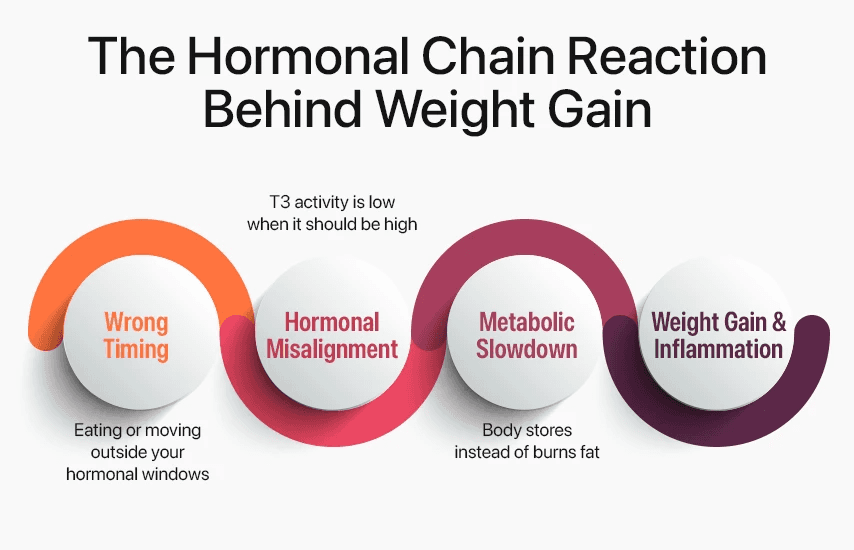
Doctors are now discovering that thyroid dysfunction also disrupts your circadian rhythm, the internal clock that controls when your body prefers to burn fat… and when it switches to storing it.³

When that rhythm falls out of sync, two major things happen:

  1. Your fat-burning phases become shorter and weaker.

  2. Your fat-storage phases become longer and stronger.

This means your metabolism still has strong fat-burning “activation peaks,” but they occur in small, predictable windows — and most people with thyroid concerns unknowingly miss them.
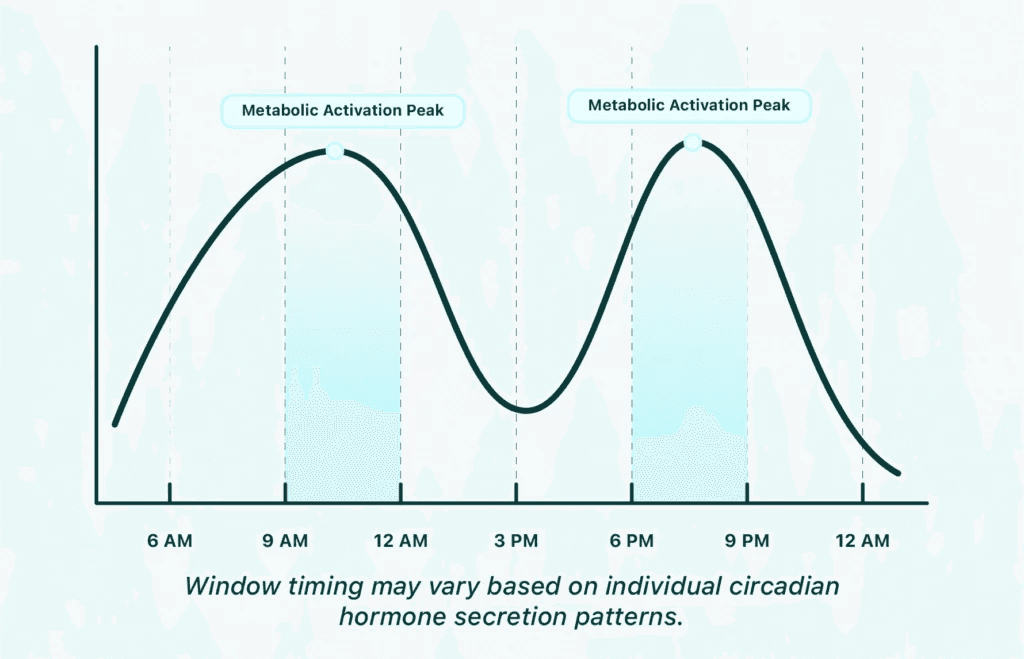

And guess what – most people with thyroid concerns miss these windows without even knowing.

They eat, rest, and exercise at times that work against their body, not with it.

And that makes weight loss impossible – even if they do everything ‘right’,” Hale adds.

This mismatch becomes even more pronounced during high-stress transitions like the New Year, when sleep shifts, routines reset abruptly, and cortisol remains elevated from months of buildup.

“Before I introduce the exact method, you must understand – the real danger isn’t weight, it’s what that weight does to your health”

“Fat gain is never the root problem – it means something in your body’s system has broken down.

When thyroid hormones misfire, the body struggles to regulate energy, blood pressure, inflammation, and even brain function.

This is why so many people notice extreme fatigue, joint aches, heavier inflammation, brain fog, and even sudden shifts in blood pressure.

When those windows are ignored, your metabolism becomes chronically disorganized.⁴

Over time, this disruption leads to serious diseases and puts your health at risk,” Dr. Hale warns.

“Chronic inflammation, liver strain, heart damage, and even a higher risk of cancer are all on the table.”

“Here’s how one woman described thyroid-related weight gain in a Facebook post that went viral in support groups.”
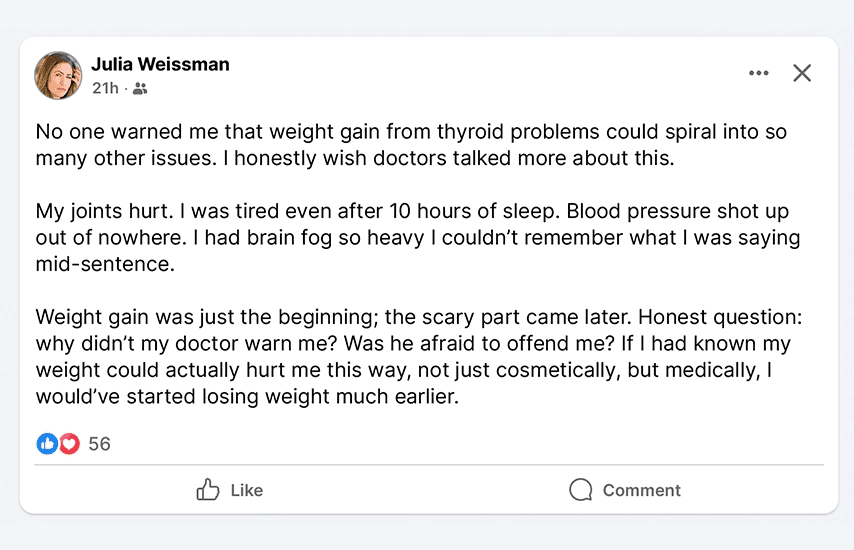

That’s why women often ask in January: ‘Why didn’t anyone tell me earlier?’ “The weight was never the real danger,” Dr. Hale concludes.

“Holiday overeating, sugar, stress, disrupted routines — they don’t cause thyroid issues,” she says. “They expose how sensitive the system has already become.”

“This approach does wonders in clinical trials, but most people still fail – here’s why,” says Dr. Hale, commenting on a Harvard study

Harvard’s research confirms it: your body has built-in fat-burning peaks every day.

Those peaks line up with certain hormonal surges, when your metabolism works at full speed.

– Dr. Nina Hale

If you eat at the wrong time, you miss that window and your body shifts straight into fat-storage mode.

But when you time it right, your metabolism kicks in like it’s supposed to.

Your body starts responding to your efforts and unlocks its fat-burning potential.

“It demands a level of precision difficult to reach on your own – yet it’s the very thing that determines if your body burns or stores fat.”

To make it work, you have to know your individual hormonal windows – and you can’t figure it out on your own.

In other words, you’d need someone who:

  • understands how thyroid issues affect your body

  • can map your individual hormonal windows

  • can match them to your routines and adjust

But let’s be honest – that kind of guidance is rare and far too expensive.

And tracking everything alone is even more unrealistic. That’s the reason it never went mainstream.

Not because it doesn’t work – but because most people simply can’t do it on their own.

Insights from top U.S. universities laid the groundwork for hormonal window programs and apps – which one do users trust the most?

With thyroid issues, paying attention is especially important – small mistakes quickly add up.

Miss your hormonal timing windows by even an hour, and fat burning shuts down completely.

The only realistic way to avoid these mistakes is automated, individual guidance.

“I’ve tried a lot of these systems with my own clients – and I’ve learned what actually works.

There’s one app that stood out. Why?”

  1. It provides the level of precision that used to require a personal specialist.

  2. It automatically calculates your daily hormonal windows.

  3. It guides you through each day, telling you exactly when to eat, move, or rest.

You simply follow notifications customized for your ‘hormonal windows’ – built on the latest metabolic research.

No spreadsheets, no notes, no overwhelming costs. It’s a Thyroid Diet Challenge.

“You don’t need bloodwork or lab tests to identify your hormonal windows – you need this short quiz instead.”

All it takes is a short set of carefully crafted questions about your lifestyle, energy patterns, digestion, and routines.

Because while thyroid rhythms follow general patterns, the exact timing is different for each person.¹⁰

That timing can be mapped by analyzing how your body behaves.

And that’s exactly what the quiz at the end of this article is designed to capture.

“I’ve seen what happens when people ignore this. That’s why I made it painfully easy to start.”


Now you’ll take a short quiz so the system can tailor the guidance to your ‘hormonal windows’.

Immediately afterward, it tells you exactly how quickly you’ll reach your weight-loss goal.

After you download the app, you can adjust your parameters at any time.

👉 You’ll get a personalized nutrition plan.
👉 You’ll have all your daily instructions neatly organized in one simple app on your phone.
👉 You’ll instantly see exactly what meals to eat, and other essential tips.

Now, you can expect faster, more consistent results than anyone trying to figure it out alone.

AS SEEN IN:

Take This Quiz and Start The Challenge

👉

Take the Quiz Now

👈

Don’t wait! Only 21 spots left at this special price.

Endocrinologist: Eating in Your ‘Hormonal Windows’ at the Start of the Year Is All You Need to Lose Weight With Thyroid Issues – but There Is a Catch

Published By

Sophia Romano

2 389 reviews and Counting

AS SEEN IN:

“I never truly grasped the scale of suffering among my thyroid patients until I met Susan.

“She went through absolute hell – panic attacks, hair falling out in clumps, and a creeping numbness in her limbs.


But things took a turn for the worse when she suddenly started gaining weight – a mental slap in the face after everything she’d already endured.”

“Many people with thyroid dysfunction struggle with excess body weight, sometimes gaining dozens of pounds,” states endocrinologist Dr. Nina Hale, Ph.D.¹

“And the worst part? Conventional weight loss methods just don’t work for them.”

This becomes especially visible after the holidays.

“Heavier meals, sugar, disrupted routines, emotional stress — the end of the year tends to magnify symptoms women were already struggling with,” Dr. Hale explains.

“Many of my patients tell me January is when the reality hits hardest. They go back to normal eating, but their body doesn’t respond.”

But the good news is science finally understands how to outsmart thyroid-related weight gain — and leading research institutions back it.

Growing scientific evidence is redefining what really drives weight gain in thyroid issues

“Until now, thyroid-related weight gain was always blamed on a slow thyroid — and that’s partly true,” explains Dr. Hale.

“When thyroid hormones drop, your metabolism slows down. Your body burns fewer calories at rest, so it stores more of what you eat.”²

“But the newest research shows something even more important.”

Doctors are now discovering that thyroid dysfunction also disrupts your circadian rhythm, the internal clock that controls when your body prefers to burn fat… and when it switches to storing it.³

When that rhythm falls out of sync, two major things happen:

  1. Your fat-burning phases become shorter and weaker.

  2. Your fat-storage phases become longer and stronger.

This means your metabolism still has strong fat-burning “activation peaks,” but they occur in small, predictable windows — and most people with thyroid concerns unknowingly miss them.


And guess what – most people with thyroid concerns miss these windows without even knowing.

They eat, rest, and exercise at times that work against their body, not with it.

And that makes weight loss impossible – even if they do everything ‘right’,” Hale adds.

This mismatch becomes even more pronounced during high-stress transitions like the New Year, when sleep shifts, routines reset abruptly, and cortisol remains elevated from months of buildup.

“Before I introduce the exact method, you must understand – the real danger isn’t weight, it’s what that weight does to your health”

“Fat gain is never the root problem – it means something in your body’s system has broken down.

When thyroid hormones misfire, the body struggles to regulate energy, blood pressure, inflammation, and even brain function.

This is why so many people notice extreme fatigue, joint aches, heavier inflammation, brain fog, and even sudden shifts in blood pressure.

When those windows are ignored, your metabolism becomes chronically disorganized.⁴

Over time, this disruption leads to serious diseases and puts your health at risk,” Dr. Hale warns.

“Chronic inflammation, liver strain, heart damage, and even a higher risk of cancer are all on the table.”

“Here’s how one woman described thyroid-related weight gain in a Facebook post that went viral in support groups.”


That’s why women often ask in January: ‘Why didn’t anyone tell me earlier?’ “The weight was never the real danger,” Dr. Hale concludes.

“Holiday overeating, sugar, stress, disrupted routines — they don’t cause thyroid issues,” she says. “They expose how sensitive the system has already become.”

“This approach does wonders in clinical trials, but most people still fail – here’s why,” says Dr. Hale, commenting on a Harvard study

Harvard’s research confirms it: your body has built-in fat-burning peaks every day.

Those peaks line up with certain hormonal surges, when your metabolism works at full speed.

– Dr. Nina Hale

If you eat at the wrong time, you miss that window and your body shifts straight into fat-storage mode.

But when you time it right, your metabolism kicks in like it’s supposed to.

Your body starts responding to your efforts and unlocks its fat-burning potential.

“It demands a level of precision difficult to reach on your own – yet it’s the very thing that determines if your body burns or stores fat.”

To make it work, you have to know your individual hormonal windows – and you can’t figure it out on your own.

In other words, you’d need someone who:

  • understands how thyroid issues affect your body

  • can map your individual hormonal windows

  • can match them to your routines and adjust


But let’s be honest – that kind of guidance is rare and far too expensive.

And tracking everything alone is even more unrealistic. That’s the reason it never went mainstream.

Not because it doesn’t work – but because most people simply can’t do it on their own.

Insights from top U.S. universities laid the groundwork for hormonal window programs and apps – which one do users trust the most?

With thyroid issues, paying attention is especially important – small mistakes quickly add up.

Miss your hormonal timing windows by even an hour, and fat burning shuts down completely.

The only realistic way to avoid these mistakes is automated, individual guidance.

“I’ve tried a lot of these systems with my own clients – and I’ve learned what actually works.

There’s one app that stood out. Why?”

  1. It provides the level of precision that used to require a personal specialist.

  2. It automatically calculates your daily hormonal windows.

  3. It guides you through each day, telling you exactly when to eat, move, or rest.

You simply follow notifications customized for your ‘hormonal windows’ – built on the latest metabolic research.

No spreadsheets, no notes, no overwhelming costs. It’s a Thyroid Diet Challenge.

“You don’t need bloodwork or lab tests to identify your hormonal windows – you need this short quiz instead.”

All it takes is a short set of carefully crafted questions about your lifestyle, energy patterns, digestion, and routines.

Because while thyroid rhythms follow general patterns, the exact timing is different for each person.¹⁰

That timing can be mapped by analyzing how your body behaves.

And that’s exactly what the quiz at the end of this article is designed to capture.

“I’ve seen what happens when people ignore this. That’s why I made it painfully easy to start.”


Now you’ll take a short quiz so the system can tailor the guidance to your ‘hormonal windows’.

Immediately afterward, it tells you exactly how quickly you’ll reach your weight-loss goal.

After you download the app, you can adjust your parameters at any time.

👉 You’ll get a personalized nutrition plan.
👉 You’ll have all your daily instructions neatly organized in one simple app on your phone.
👉 You’ll instantly see exactly what meals to eat, and other essential tips.

Now, you can expect faster, more consistent results than anyone trying to figure it out alone.

“I never truly grasped the scale of suffering among my thyroid patients until I met Susan.

“She went through absolute hell – panic attacks, hair falling out in clumps, and a creeping numbness in her limbs.


But things took a turn for the worse when she suddenly started gaining weight – a mental slap in the face after everything she’d already endured.”

“Many people with thyroid dysfunction struggle with excess body weight, sometimes gaining dozens of pounds,” states endocrinologist Dr. Nina Hale, Ph.D.¹

“And the worst part? Conventional weight loss methods just don’t work for them.”

This becomes especially visible after the holidays.

“Heavier meals, sugar, disrupted routines, emotional stress — the end of the year tends to magnify symptoms women were already struggling with,” Dr. Hale explains.

“Many of my patients tell me January is when the reality hits hardest. They go back to normal eating, but their body doesn’t respond.”

But the good news is science finally understands how to outsmart thyroid-related weight gain — and leading research institutions back it.

Growing scientific evidence is redefining what really drives weight gain in thyroid issues

“Until now, thyroid-related weight gain was always blamed on a slow thyroid — and that’s partly true,” explains Dr. Hale.

“When thyroid hormones drop, your metabolism slows down. Your body burns fewer calories at rest, so it stores more of what you eat.”²

“But the newest research shows something even more important.”

Doctors are now discovering that thyroid dysfunction also disrupts your circadian rhythm, the internal clock that controls when your body prefers to burn fat… and when it switches to storing it.³

When that rhythm falls out of sync, two major things happen:

  1. Your fat-burning phases become shorter and weaker.

  2. Your fat-storage phases become longer and stronger.

This means your metabolism still has strong fat-burning “activation peaks,” but they occur in small, predictable windows — and most people with thyroid concerns unknowingly miss them.


And guess what – most people with thyroid concerns miss these windows without even knowing.

They eat, rest, and exercise at times that work against their body, not with it.

And that makes weight loss impossible – even if they do everything ‘right’,” Hale adds.

This mismatch becomes even more pronounced during high-stress transitions like the New Year, when sleep shifts, routines reset abruptly, and cortisol remains elevated from months of buildup.

“Before I introduce the exact method, you must understand – the real danger isn’t weight, it’s what that weight does to your health”

“Fat gain is never the root problem – it means something in your body’s system has broken down.

When thyroid hormones misfire, the body struggles to regulate energy, blood pressure, inflammation, and even brain function.

This is why so many people notice extreme fatigue, joint aches, heavier inflammation, brain fog, and even sudden shifts in blood pressure.

When those windows are ignored, your metabolism becomes chronically disorganized.⁴

Over time, this disruption leads to serious diseases and puts your health at risk,” Dr. Hale warns.

“Chronic inflammation, liver strain, heart damage, and even a higher risk of cancer are all on the table.”

“Here’s how one woman described thyroid-related weight gain in a Facebook post that went viral in support groups.”


That’s why women often ask in January: ‘Why didn’t anyone tell me earlier?’ “The weight was never the real danger,” Dr. Hale concludes.

“Holiday overeating, sugar, stress, disrupted routines — they don’t cause thyroid issues,” she says. “They expose how sensitive the system has already become.”

“This approach does wonders in clinical trials, but most people still fail – here’s why,” says Dr. Hale, commenting on a Harvard study

Harvard’s research confirms it: your body has built-in fat-burning peaks every day.

Those peaks line up with certain hormonal surges, when your metabolism works at full speed.

– Dr. Nina Hale

If you eat at the wrong time, you miss that window and your body shifts straight into fat-storage mode.

But when you time it right, your metabolism kicks in like it’s supposed to.

Your body starts responding to your efforts and unlocks its fat-burning potential.

“It demands a level of precision difficult to reach on your own – yet it’s the very thing that determines if your body burns or stores fat.”

To make it work, you have to know your individual hormonal windows – and you can’t figure it out on your own.

In other words, you’d need someone who:

  • understands how thyroid issues affect your body

  • can map your individual hormonal windows

  • can match them to your routines and adjust


But let’s be honest – that kind of guidance is rare and far too expensive.

And tracking everything alone is even more unrealistic. That’s the reason it never went mainstream.

Not because it doesn’t work – but because most people simply can’t do it on their own.

Insights from top U.S. universities laid the groundwork for hormonal window programs and apps – which one do users trust the most?

With thyroid issues, paying attention is especially important – small mistakes quickly add up.

Miss your hormonal timing windows by even an hour, and fat burning shuts down completely.

The only realistic way to avoid these mistakes is automated, individual guidance.

“I’ve tried a lot of these systems with my own clients – and I’ve learned what actually works.

There’s one app that stood out. Why?”

  1. It provides the level of precision that used to require a personal specialist.

  2. It automatically calculates your daily hormonal windows.

  3. It guides you through each day, telling you exactly when to eat, move, or rest.

You simply follow notifications customized for your ‘hormonal windows’ – built on the latest metabolic research.

No spreadsheets, no notes, no overwhelming costs. It’s a Thyroid Diet Challenge.

“You don’t need bloodwork or lab tests to identify your hormonal windows – you need this short quiz instead.”

All it takes is a short set of carefully crafted questions about your lifestyle, energy patterns, digestion, and routines.

Because while thyroid rhythms follow general patterns, the exact timing is different for each person.¹⁰

That timing can be mapped by analyzing how your body behaves.

And that’s exactly what the quiz at the end of this article is designed to capture.

“I’ve seen what happens when people ignore this. That’s why I made it painfully easy to start.”


Now you’ll take a short quiz so the system can tailor the guidance to your ‘hormonal windows’.

Immediately afterward, it tells you exactly how quickly you’ll reach your weight-loss goal.

After you download the app, you can adjust your parameters at any time.

👉 You’ll get a personalized nutrition plan.
👉 You’ll have all your daily instructions neatly organized in one simple app on your phone.
👉 You’ll instantly see exactly what meals to eat, and other essential tips.

Now, you can expect faster, more consistent results than anyone trying to figure it out alone.

AS SEEN IN:

Take This Quiz and Start The Challenge

Take the Quiz Now

Don’t wait! Only 21 spots left at this special price.